
Two School of Health Graduates Earn Fulbright Awards to Advance Global Health Research

(February 6, 2026) — Two School of Health alumni have been awarded prestigious Fulbright grants to pursue research in New Zealand and India that blends rigorous science with community-centered public health.
Sahana Arumani (H’25, G’25) and Shagun Gandhi (H’25), both human science majors, will spend the next several months conducting research on their projects that reflect what the major at the School of Health aims to cultivate: scientists who can think across molecular biology, public health, culture and lived experience.
“Human science really appealed to me because it was such a deliberate blend of hard science and public health,” Arumani said. “It gave me the foundation to think about disease not just biologically, but in the context of people’s lives.”
Arumani and Gandhi join 40 other Fulbright recipients across the university, making Georgetown the No. 1 producer of Fulbright U.S. Student Program awardees in the country for grant year 2025-2026.
Studying Disease at the Intersection of Humans, Animals, and Environment
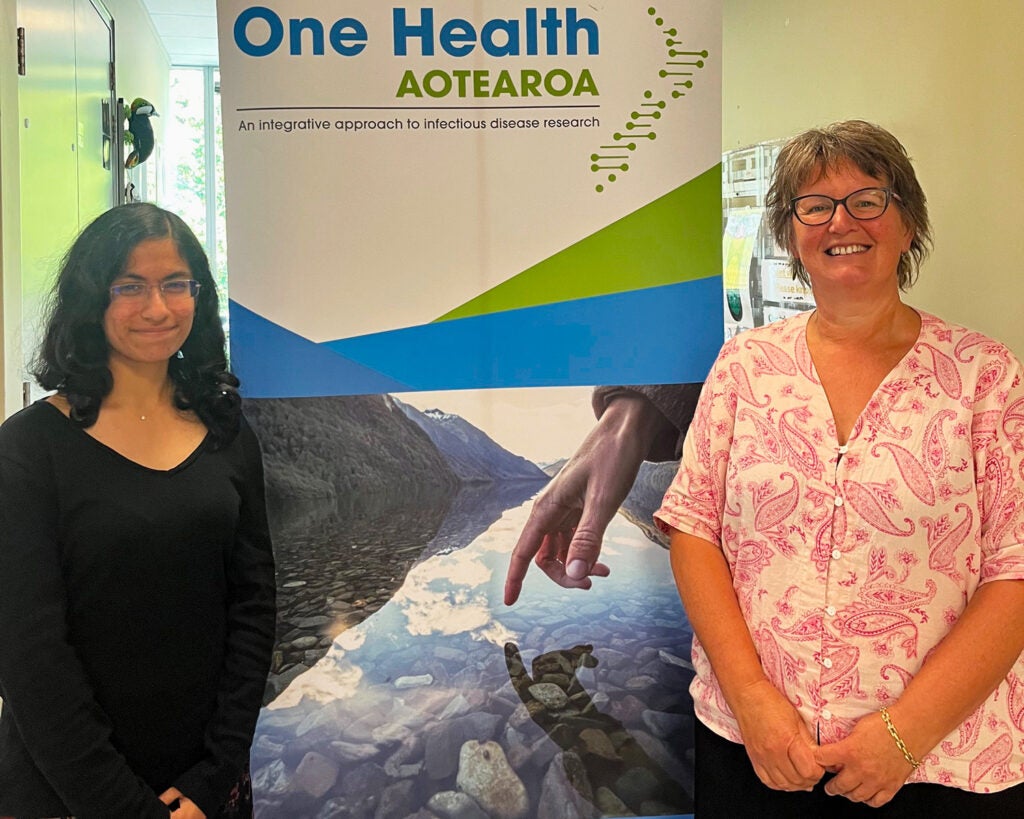
(From l) Sahana Arumani (H’25, G’25) with her mentor, Jackie Benschop, PhD, at the Hopkirk Research Institute on the campus of Massey University.
Working under the mentorship of veterinarian and epidemiologist Jackie Benschop, PhD, at Massey University in Palmerston North, New Zealand, Arumani is assisting with field sampling of waterways to map leptospirosis strains following major flooding events. Leptospirosis is a zoonotic disease, one that jumps from animals to humans, that disproportionately affects agricultural workers and Indigenous communities in New Zealand.
“Leptospirosis is often underdiagnosed because the symptoms look like the flu,” Arumani said. “But in New Zealand, especially after climate-driven flooding, exposure risk has increased. Understanding where the bacteria is present and how people understand the disease is critical.” Part of her project also includes contributing to public health literature reviews and qualitative research on disease awareness campaigns.
Arumani is also interested in synthesizing the limited but concerning data on pregnancy complications associated with leptospirosis, and understanding how occupational exposure compounds the risk. “That gap in the literature stood out to me,” Arumani said. “It’s a place where epidemiology, occupational health and women’s health intersect.”
Arumani credits the School of Health faculty with encouraging her to pursue interdisciplinary questions early on. She began her undergraduate career doing wet-lab research before transitioning to public health-focused projects, including an honors thesis on HPV vaccine uptake. After starting her accelerated master’s program, Arumani became interested in the concept of “One Health,” the idea that human, animal and environmental health are inextricably linked.
“My mentors helped me connect the dots with all my interests,” said Arumani.
That encouragement extended to the Fulbright itself. “Professor Andrew Lee was someone who really demystified the process for me,” Arumani said. “Seeing someone who had received a Fulbright themselves and wanted students to do the same made it feel possible.”
Now accepted to medical school and aspiring to become an Epidemic Intelligence Service officer at the Centers for Disease Control and Prevention, Arumani sees the Fulbright as a formative step.
“I want to be a physician who understands outbreaks from the ground up,” she said. “Being embedded in another country’s public health system teaches you how preparedness actually works, or doesn’t, at the community level.”
Centering the Patient Voice in Cancer Survivorship

Shagun Gandhi (H’25)
While Arumani tracks bacteria in New Zealand’s rural waterways, Gandhi is navigating the bustling wards of Tata Memorial Hospital in Mumbai, India’s largest cancer center. Her project focuses on head and neck cancer survivorship, an area she says is often overshadowed by the urgency of treatment. Gandhi’s time at Georgetown’s Lombardi Comprehensive Cancer Center, where she hosted art workshops for patients, taught her that “curing” is only one part of the journey.
“So much attention is rightly placed on curing cancer,” Gandhi said. “But survivorship, mental health, quality of life, long-term functioning — these things can get lost, especially in high-burden treatment settings.”
While the global average for head and neck cancers sits at roughly 5% of all cancer cases, in India, that figure skyrockets to 30%, largely driven by the use of smokeless tobacco products like gutka.
At Tata Memorial’s ACTREC (Advanced Centre for Treatment, Research and Education in Cancer) campus, Gandhi is interviewing head and neck cancer survivors who are one to three years post-treatment in order to refine a survivorship questionnaire that accounts for local nuances, such as the role of faith, village priests, and traditional Ayurvedic medicine in a patient’s care journey. The tool blends quantitative measures with open-ended questions designed to capture experiences that standard Western assessments may miss.
“A lot of survivorship tools are developed in the U.S. or Europe,” Gandhi said. “They don’t always translate to places where family decision-making, faith, or access barriers shape how people experience illness.”
Gandhi traces her preparation for her Fulbright to her human science curriculum and her research training with Jan LaRocque, PhD. Through the Laidlaw Scholars Program, she began conducting independent molecular biology research as a first-year student and eventually worked in LaRocque’s lab researching the molecular mechanisms of DNA double-strand break repair, a pathway critical to maintaining genomic stability and preventing cancer.
“My wet-lab experience taught me ownership,” Gandhi said. “In the human science major, you’re expected to ask your own questions and figure out how to answer them. That’s exactly what the Fulbright also requires.”
Her lab work gave her analytical tools, while experiences outside the lab, including scribing for a head and neck cancer surgeon, volunteering with oncology patients, and working at the Arlington Free Clinic, reshaped how she understood diseases’ impact on patients.
“Molecular research is very clear-cut,” she said. “Public health research is a bit messier, but it’s also closer to people’s lived realities. Georgetown gave me space to learn both.”
At Tata Memorial, Gandhi has been struck by patients’ optimism and trust in physicians, even amid immense system pressures, where patients see physicians in treatment rooms alongside several other patients and people line hallways and stairwells waiting for treatment.
“Many patients are reluctant to complain,” said Gandhi. “There’s this feeling of gratitude for survival itself. That makes survivorship conversations even more important, because people may not ask for what they need unless we ask first.”
She hopes her findings will inform care at Tata Memorial’s new adult survivorship clinic and spark similar efforts elsewhere in India.
For Gandhi, the project is a culmination of her academic work and her cultural identity. “Being ethnically Indian, I became much more connected with my culture at Georgetown,” she explains. “It felt like all the pieces — my clinical experience, my research, and my heritage — came together with this project.”
As Fulbright recipients, both students are serving as academic ambassadors abroad, but also carrying Georgetown’s commitment to holistic, globally engaged health research with them.
“This is exactly what public health was meant to be,” Arumani said. “Unifying, human-centered, and grounded in community.”
Heather Wilpone-Welborn
GUMC Communications