
Student-Led Initiative Expands Health Equity Education and Career Pathways
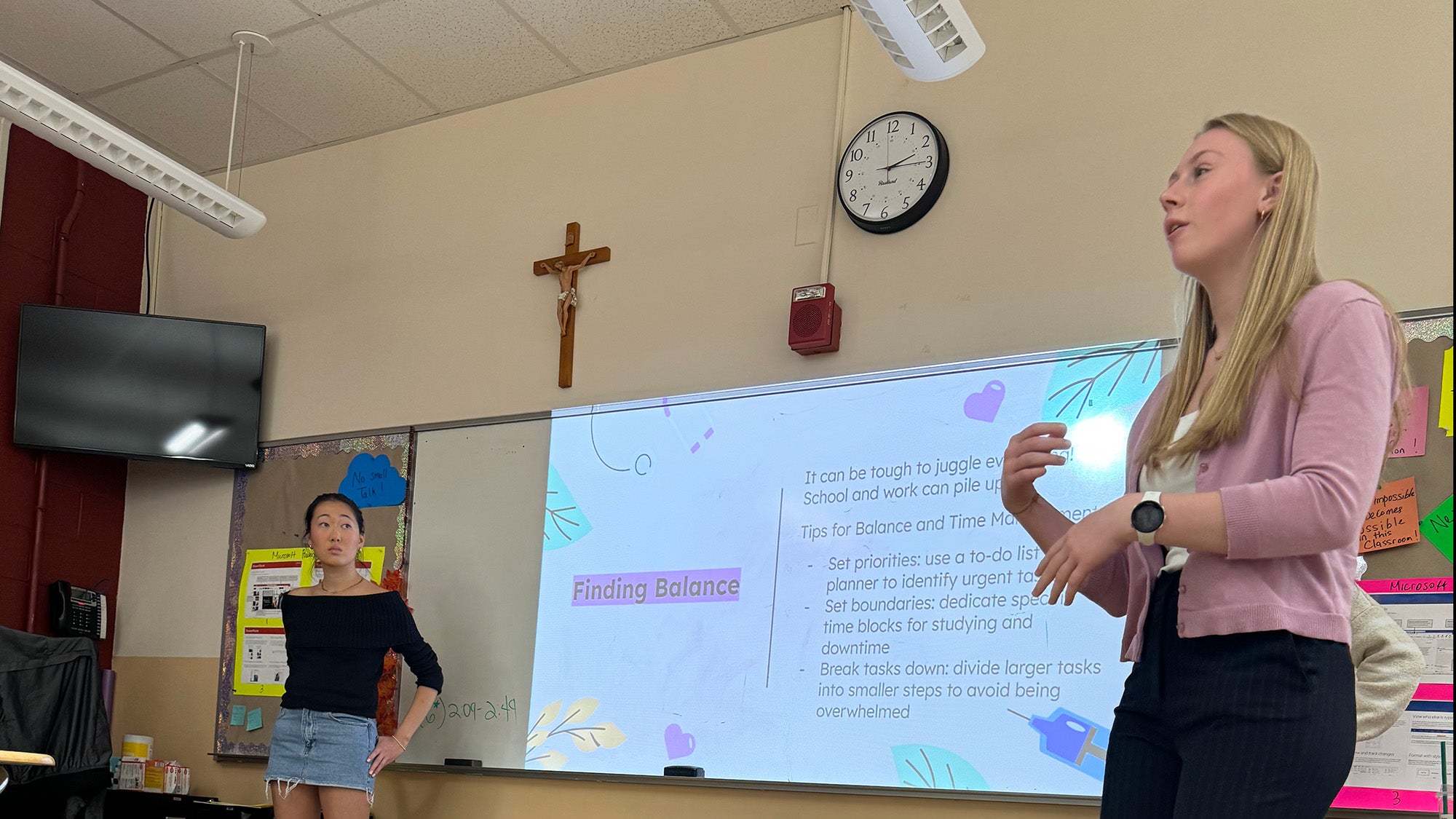
Top Image: Through activities including weekly health-related lessons, Georgetown students participating in GUBEACON aim to empower high school students at Don Bosco Cristo Rey High School to advocate for their own health.
(May 8, 2026) — At the School of Health, a student-run organization is working to close gaps in health literacy and expand career pathways among Washington, D.C., youth, one classroom, one mentorship, and one creative lesson at a time.
GUBEACON (shorthand for Georgetown University Building Equity and Advocacy in Community Outreach and Navigation), founded by undergraduate students passionate about health equity, has grown from a small campus initiative into a multifaceted collaboration with Don Bosco Cristo Rey High School & Corporate Work Study Program. Through weekly health-related lessons, mentorship programs and a student-led health fair, the group aims to empower high school students with the knowledge and confidence to advocate for their own health.
“We wanted to do something that went beyond campus,” said Jaskirit Bhalla (H’26), one of GUBEACON’s leaders. “Health literacy is such a foundational issue. If these high school students understand it early, it can shape outcomes for the rest of their lives.”
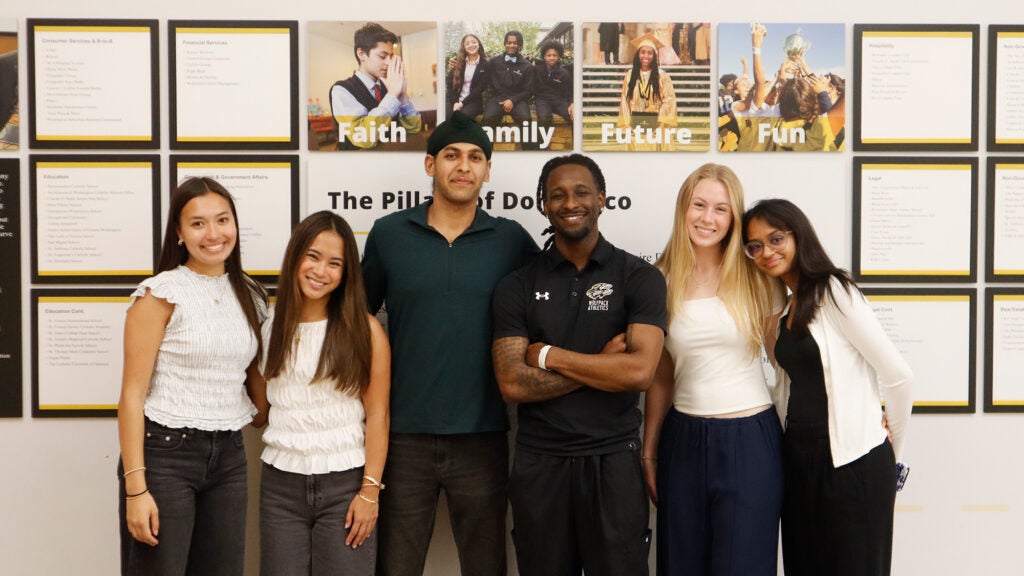
Georgetown students including GUBEACON co-leaders Alison Lee (H’26) and Jaskirit Bhalla (H’26) (second and third from left) stand with Eric Anthony, PE and Health Teacher, Don Bosco Cristo Rey High School (third from right).
From Classroom to Community Impact
The idea for GUBEACON’s work emerged after Bhalla and fellow student leader Alison Lee (H’26) read through a health needs assessment of Washington, D.C., in a Health Promotion and Disease Prevention class taught by Joan Riley, MS, MSN, Engelhard senior scholar and associate professor in the School of Health. Bhalla and Lee noticed stark disparities in health literacy across the city’s wards, particularly in Wards 7 and 8, where socioeconomic barriers have historically limited access to healthcare information.
Bhalla and Lee decided to act on the information they learned from the assessment and began reaching out to schools in underserved communities with the idea of expanding access to health literacy and eventually formed a partnership with Don Bosco Cristo Rey High School. For Kevin Sullivan (SFS ‘14), director of the Niehaus Center for Work-Study & Career Partnerships at Don Bosco Cristo Rey, the collaboration reflects a deeper alignment between the two institutions.
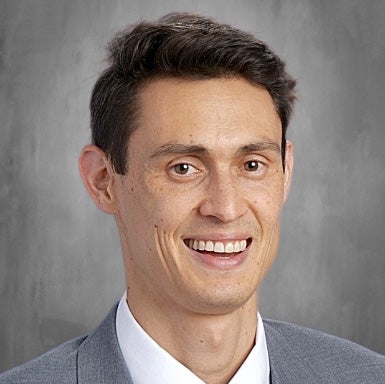
Kevin Sullivan (SFS ‘14)
“Our students are incredibly motivated, but access to healthcare knowledge and career pathways can be limited,” Sullivan said. “GUBEACON brings energy, creativity and a real commitment to service that resonates with our mission.”
Sullivan noted the program not only improves health literacy, but also equips students with skills in public speaking, advocacy and critical thinking. “It’s about preparing them to be advocates — for themselves, their families and their communities,” he said.
Teaching Through Connection
The collaboration quickly evolved into a hands-on educational program embedded within the school’s ninth-grade health curriculum. Each week, Georgetown students lead interactive lessons on topics like nutrition, vital signs and disease prevention. Instead of traditional lectures, GUBEACON emphasizes engagement. High school students learn how to take blood pressure, interpret food labels and apply concepts through activities. The group received support from the School of Health’s experiential learning fund to help buy supplies for their weekly sessions.
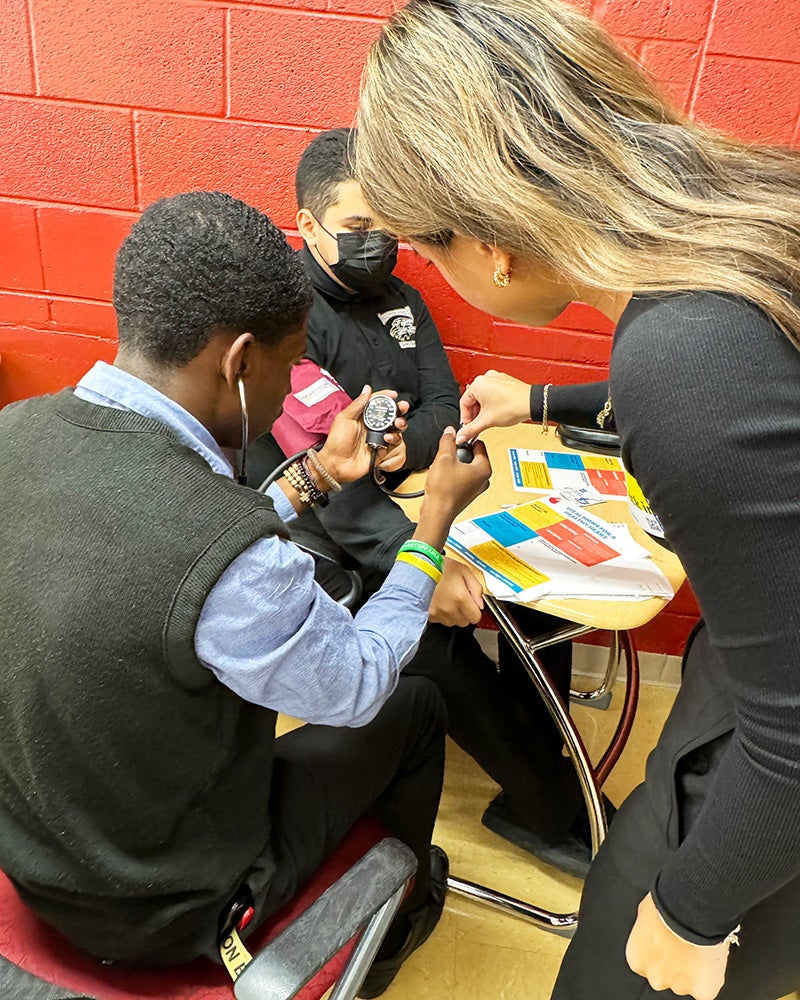
Georgetown students taught the ninth graders how to take a blood pressure reading.
“We didn’t want to just talk at them,” Lee said. “We wanted them to participate, ask questions and actually remember what they learned.” A key component of GUBEACON’s approach is its use of the “teach-back” method, a technique often used in clinical settings. After learning a concept, high school students are asked to explain it in their own words, reinforcing understanding and building confidence.
The sessions are structured in small groups, allowing Georgetown volunteers to serve not just as instructors, but also as mentors. “That peer-to-peer connection is huge,” Bhalla said. “We’re close enough in age that students feel comfortable asking about college, careers or even just daily life.”
That mentorship has expanded into a formal pilot program, pairing GUBEACON students with 10th- and 11th-grade mentees. Participants meet regularly to discuss college pathways, healthcare careers and personal goals.
For many high school students, the exposure is transformative. “They don’t always have access to information about what it takes to become a nurse, a doctor, or work in health policy,” Lee said. “We’re helping them see those paths earlier.”
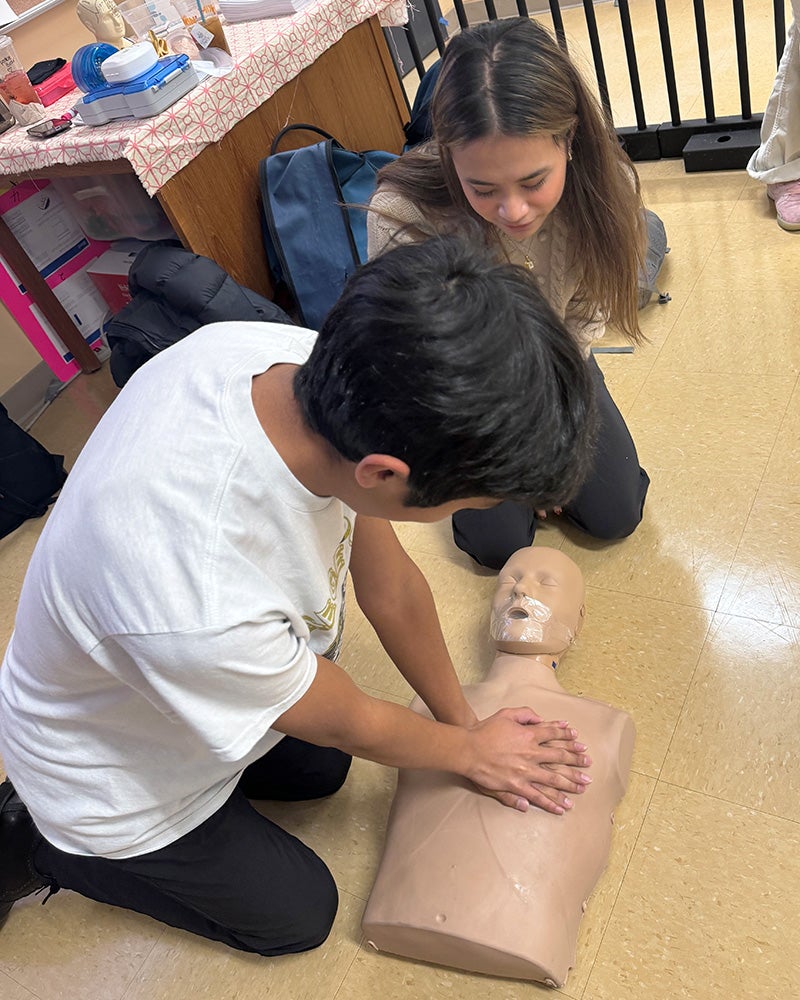
Alison Lee (H’26) helped lead a session teaching students how to administer CPR.
“The program helped me learn more about different careers in healthcare and business, and it helped me grow my interest in psychology and nursing,” said Marilyn Guerra, a Don Bosco Cristo Rey student. “It gave me a better understanding of what to expect in college and motivated me to keep working toward my goals. My mentor even recommended many books for me to read.”
The program’s impact culminated this spring in a student-organized health fair, where ninth graders presented projects on topics ranging from nutrition to chronic disease prevention. The event drew classmates, faculty and staff, turning the classroom into a hub of peer education.
One group compared fast-food meals for their presentation to illustrate differences in calorie and nutrient content, making complex health concepts accessible and relatable. “It was incredible to see how much they had grown,” Bhalla said. “They weren’t just learning, they were teaching others.”
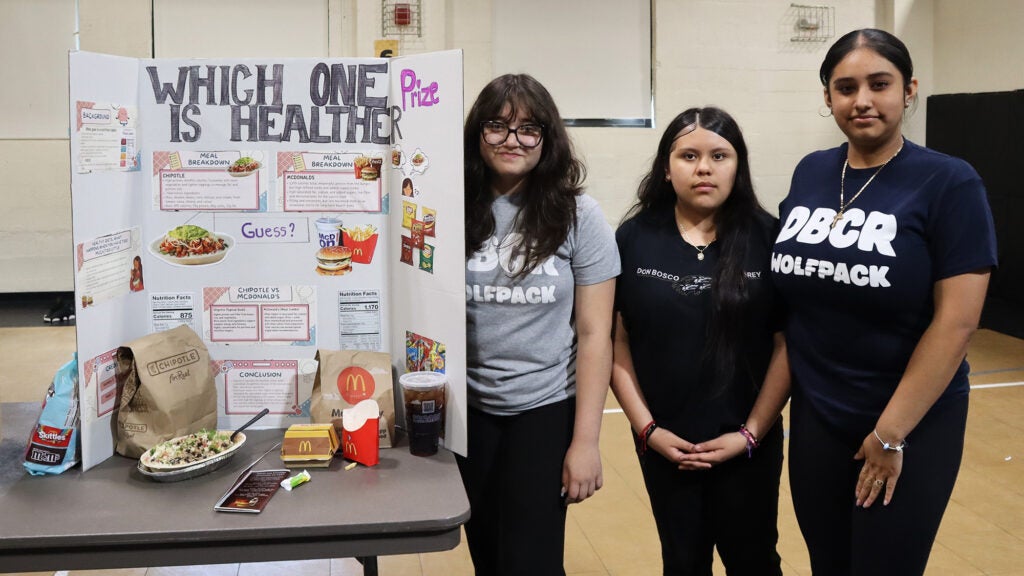
This spring, ninth-grade Don Bosco Cristo Rey students organized a health fair at which they presented projects inspired by what they had learned during GUBEACON sessions, including this nutritional comparison of fast-food meals.
Growing Beyond the School of Health
While GUBEACON is rooted in Georgetown’s School of Health, its membership spans multiple disciplines, from policy and business to data science. That interdisciplinary approach allows the organization to address health literacy from multiple angles.
“We realized early on that health literacy isn’t just a health issue,” Lee said. “It intersects with education, economics and a host of other factors. Bringing in students from different majors strengthens what we do.”
The group has also recently secured funding through Georgetown’s Center for Social Justice, enabling plans to expand programming to additional schools.
For Bhalla and Lee, the motivation remains deeply personal. “Seeing students excited to learn, asking questions and realizing what they’re capable of, that’s what keeps us going,” Lee said. Bhalla echoed that sentiment: “This is what Georgetown is about: using what we learn to serve others. And we’re just getting started.”
Heather Wilpone-Welborn
GUMC Communications