
Frequently Asked Questions for MHSA Applicants
About Applying for the Program
What are the admission requirements?
Find complete admission requirements on the Graduate School of Arts & Sciences page. Each applicant is reviewed holistically by the faculty selection committee.
Is full-time work experience required before applying to the program?
Yes. Because the program targets early-to-mid career working professionals, promising applicants will typically have 1–5 years of experience in the healthcare sector. There are many ways to gain relevant experience, including undergraduate health care-related research, internships, fellowships, volunteer work, healthcare coursework, and other experiential learning opportunities that provide exposure to the field.
Is there any specific undergraduate degree or background/experience required?
No. Students come from a variety of backgrounds/experiences. We have had students with degrees in business, biology, history, sociology, and more. Some have worked in the field as technicians or clinicians or have advanced degrees in related areas (public health, medicine, law). The diversity of backgrounds is a microcosm of the health care field and enriches the educational experience, allowing students to learn from each other.
Are there any prerequisites for the program?
No. However, successful completion of a financial accounting course is strongly recommended, as are advanced Microsoft Excel skills. The successful applicant will demonstrate a strong quantitative capacity via transcripts and test scores.
Is experience or current work in the health care field required to understand material/be successful in the program?
Applicants should have work experience in the health care sector. Faculty will expect students to have some level of applied knowledge of how care is organized, delivered, or financed. Experiential projects are built around current employment during the program.
Are standardized tests required?
No standardized tests are required.
What are characteristics of a successful student in the program?
The most important characteristics are: motivation to understand the complexity of the health care system, willingness to work diligently and develop strong management skills, and leadership potential to make improvements to the health care system. The effective health care administrator is a leader and critical thinker. The attributes for managerial leadership supported by critical thinking will be developed and honed throughout the program. However, applicants must demonstrate a capacity for strong quantitative skills and strong writing skills prior to entry into the program.
Can I transfer courses from another university?
Up to 10 credits may be transferred. However, because this is a unique, sequential cohort-based program, transferring credits is not common. The credits must be from comparable courses, taken at an accredited institution, not used toward a conferred degree or certificate, and successfully completed with a grade of B or above. The decision to grant credit is at the discretion of the program director and department chair. Program faculty who teach in the subject area will evaluate course descriptions and objectives to ensure there is alignment with MHSA courses.
What is the application deadline?
The priority application deadline is January 15. All applicants, especially those who wish to be considered for a departmental scholarship, are encouraged to submit their application and all support documents by that date. The final application deadline is June 1. Application materials and other admissions-related information can be found on the Graduate School of Arts & Science webpage for the program under the “Admissions Requirements” section.
Does the program allow for part-time study?
The MHSA is presented in an executive format, with part-time evening courses in a 42-credit hour program. The program is designed for professionals who would like to complete their degree while they pursue full-time employment. Based on a structured cohort model, prospective applicants should carefully review the two-year program of study to ensure they have flexibility to meet all obligations.
Does the program accept international applicants?
Yes, but there are additional requirements. Degrees earned outside of the U.S. require evaluation by World Education Services (www.wes.org). Applicants must have earned the equivalent of a U.S. bachelor’s degree with a cumulative GPA of at least 3.0. If your first language is not English, the TOEFL is required. However, if your bachelor’s degree is from an institution where English was the language of instruction, the TOEFL requirement is waived. Please note: The MHSA program does not sponsor student visas.
Is there a New Student Orientation?
Yes. Orientation is a two-part process. Students receive orientation materials covering a range of topics approximately 4–6 weeks before classes begin. Closer to the start of the term, a virtual orientation session is held, giving students the opportunity to meet peers and faculty and learn about program resources before beginning coursework.
What if I need to take a leave of absence?
If you need to interrupt your studies, a leave of absence may be granted for one year.
About the Program
How is an MHSA different from an MHA? Why should I choose this program?
While both Master of Health Administration (MHA) and Master of Science in Health Systems Administration (MHSA) programs prepare students for healthcare leadership roles, the distinction lies in how students are trained to understand and manage healthcare organizations.
The Georgetown MHSA is intentionally designed around a health systems perspective that emphasizes the larger healthcare ecosystem and interrelationships between healthcare organizations and other key stakeholders. Rather than focusing solely on management of a single organization, the program prepares students to understand healthcare as a complex, interconnected system — one that includes health systems, payers, policymakers, technology companies, community organizations, and many other forces that influence how care delivers quality and value. With an MHSA degree, students are equipped for a wider set of goals and career aspirations. Our graduates are not only leaders in healthcare organization leaders, they are leaders in consulting, government, pharmaceutical, medical device development, and more.
A care-for-the-whole-person, systems-based approach reflects Georgetown University’s broader educational philosophy and is especially relevant in today’s healthcare environment, where leaders are expected to apply systems thinking, navigate complexity, work across organization and sector boundaries, and respond to rapid changes in policy, practice, and emerging care delivery models.
What are typical careers for which the MHSA is appropriate?
MHSA graduates take on a variety of managerial roles in a range of organizations that finance, regulate, supply, and provide health services. These include health insurance plans, organizations involved in health service investment, government agencies, advocacy groups, consulting firms, and supply companies. The largest employers of program graduates are hospitals and health systems, but increased opportunities are expected in medical group practices, ambulatory care centers, home health services, long-term care institutions, freestanding diagnostic centers, and wellness programs. A significant number of graduates work in consulting organizations and professional associations. Health care is a dynamic and still growing field. New opportunities are continually emerging for which this degree provides an excellent foundation.
Is the program accredited?
The MHSA program is accredited by the Commission on the Accreditation of Healthcare Management Education (CAHME). Accreditation is evidence that programs are high quality, competency-based, and responsive to the needs of students, employers, and a dynamic health care industry. Note: The program was most recently accredited in 2025.
How long will it take to complete the program?
New cohorts are admitted each August and are scheduled to graduate 21 months later.
What is a blended/hybrid program?
The MHSA program provides students with a unique environment that combines four weeklong in-person On-Campus Intensives and five 12-week virtual semesters. This flexible approach offers academic rigor, exceptional teaching, and connection to the Georgetown campus and overall learning community. The majority of coursework is offered in a virtual learning environment using web-based technologies to provide interaction with faculty and the cohort.
Each semester includes two or three courses delivered in weekly real-time sessions via Zoom, typically scheduled for Tuesday, Wednesday, and Thursday evenings from 6:30–8:30 or 7:00–9:00 p.m. ET. Up to one course per semester may consist of self-paced learning activities or individual and group integrative seminars with opportunities for faculty interaction. This combination of in-person intensives, live virtual instruction, and online collaboration creates a rich learning experience and supports the development of meaningful personal and professional relationships among students with diverse health care industry perspectives.
What are On-Campus Intensives and what is their purpose?
Each August and April, On-Campus Intensives (OCIs) bring students together face-to- face for a full week. OCIs typically occur in year of the program. Each of the four OCIs is a truly intense experience, with a fully-packed schedule consisting of academic classes, site visits in and around DC, experiential learning, and social opportunities that enable students to build and sustain strong relationships with each other and faculty.
The OCIs include opportunities to get to know the Georgetown campus, as well as to take advantage of health systems and policy resources unique to our nation’s capital.
What is the Integrative Seminar (longitudinal curriculum)?
The Integrative Seminar series is centered on a competency-based experiential project that runs throughout three academic terms. This experiential methodology allows students to demonstrate mastery of course competencies in real-world scenarios and advance the mission of a health care entity. Depending upon the needs of the organization, the culminating assignment will vary, but may include the development and formal defense of a comprehensive strategic plan, marketing plan, or business plan. Students will also deliver capstone presentation based on this work during the final OCI week.
Is there a residency or internship requirement?
Because the program was designed for students with full-time employment and because of the hybrid modality, there is no residency or internship. However, students do complete an experiential based project throughout the second year. Faculty work closely with students to ensure projects support their career objectives.
Does the program have a global or international component? Is it mandatory?
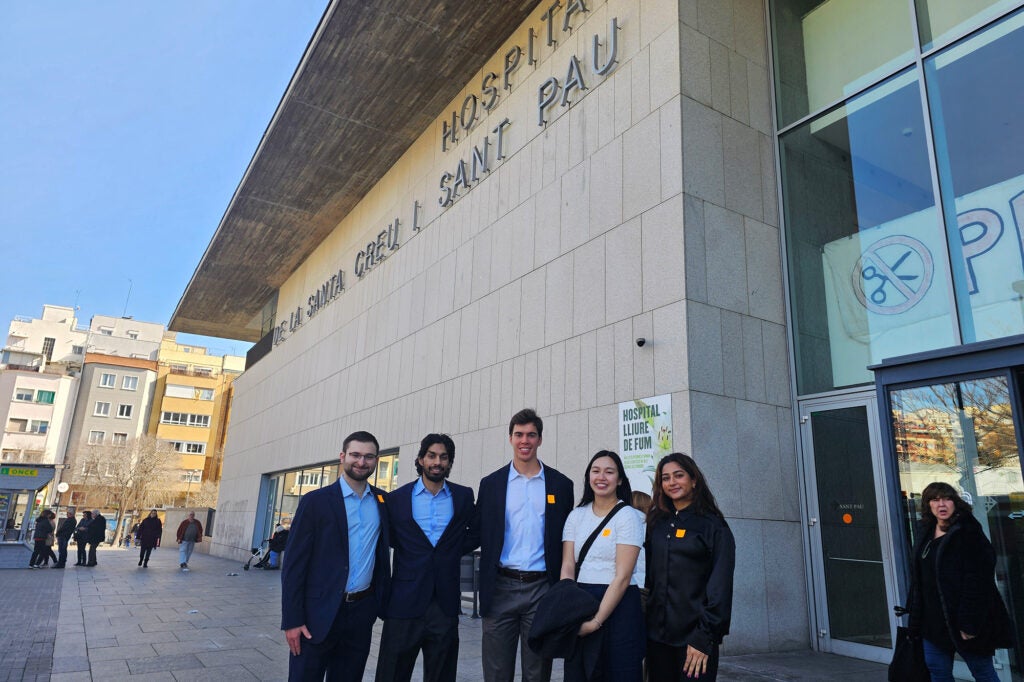
MHSA students have the opportunity to participate in an optional comparative health system Global Experience involving site visits, engaging with health system leaders and academic faculty, and team-based activities. Previous trips have included Spain; São Paulo, Brazil; Seoul, South Korea; Singapore; and Foz do Iguaçu, Brazil.
What is the Professional Coaching Program?
Upon beginning the program, students assess their career aspirations and leadership skills. Based on these findings, students develop a Professional Development Plan (PDP). According to the goals identified in the PDP, students may have the option to work with a professional career coach. Students work in partnership with the coach to determine expectations, but the PDP should guide the interactions.
Are there other forms of career support?
Upon enrollment, students join our learning community of faculty, 400+ alumni, peers, and industry partners and immediately gain access to an extensive network of contacts. Also, the Department of Health Care Management & Policy, Graduate Career Center, and the Health Systems Administration Student Association provide a number of career development seminars and programming opportunities.
I Have Other Questions, Who Should I Contact?
Feel free to reach out to the Associate Director of Graduate Studies with any additional questions or to request more information.