
Georgetown School of Health 2026 Commencement Speaker: Kedar S. Mate, MD
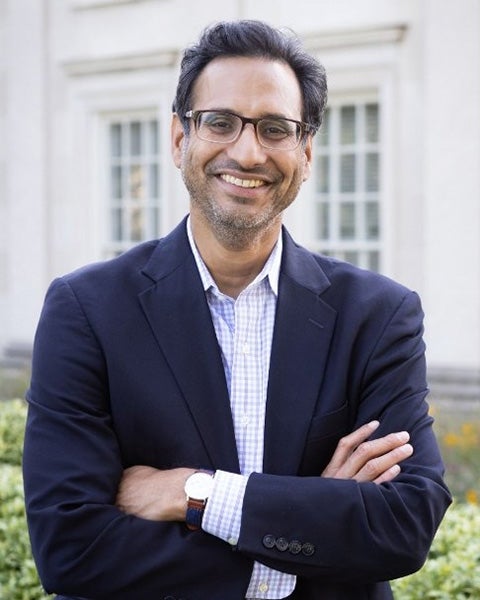
Kedar S. Mate, MD
(April 27, 2026) — As a young boy growing up in New Jersey, Kedar S. Mate, MD, made regular trips with his family to India, where his father was raised. The contrasts between those two worlds planted a seed of injustice early.
“Even at a young age, it bothered me that I could get on a plane and fly from JFK Airport to Bombay, while my cousins had not yet been in a car,” Mate said.
He came to understand that the difference was not about effort or ability. It was about “the accidents of birth,” or the circumstances of place, history and opportunity that determine how much of the world is available to any one of us.
“That was the beginning of my awareness that where we are born, where we grow up, who we encounter, these lead to structured advantages for some and disadvantages for others,” he said.
In medicine, those accidents of birth and opportunity show up in who gets timely care and who doesn’t, who recovers and who doesn’t, whose neighborhood has a well-staffed hospital and whose doesn’t.
Mate’s career has taken him through roles in medicine, policy and technology, all in pursuit of what he calls “hyperscaling forces.”
“This is perhaps a technology term, but what it means simply is what are the levers that enable us to improve health for the largest numbers of people possible,” he said.
This conviction that equity is foundational to the delivery of care itself resonates with Georgetown’s own founding principle of cura personalis, care for the whole person, and extends it to care of the whole community.
A Career of Deliberate Detours
The son of a pediatrician father and a microbiologist mother, Mate said he was in some ways born or nurtured into medicine, but had to come to it his own way. Each stop along the way was an experiment in a different kind of scaled impact.
While studying American history at Brown University, he took a hiatus to work on an HIV initiative in South India, his first encounter with the challenge of delivering care at population scale in a resource-constrained setting.
He then went to Peru to work at Partners In Health with the organization’s co-founder, the late Paul Farmer, MD. There he found himself surrounded by economists, anthropologists, nurses and researchers all grappling with the same problem from different angles.
It was that experience that showed him how medicine could serve as a force for structural justice.
“I realized the most practical solutions to the problem of scaled inequity involved taking care of the most fundamental need — the health — of people I wished to serve,” he said.
“I realized the most practical solutions to the problem of scaled inequity involved taking care of the most fundamental need — the health — of people I wished to serve.”
He went on to earn his MD at Harvard Medical School, though not before he took a leave to help run the WHO’s 3 by 5 Initiative in Geneva, a program set up in 2003 to scale antiretroviral treatment for HIV/AIDS in low- and middle-income countries.
For Mate, what others might see as detours were actually essential stops. Each of these early roles enabled him to explore “how you take something that works for some people and make it work for everyone.”
After medical school, Mate began advising the federal government to explore domestic policy as a hyperscaling force. At the Centers for Medicare & Medicaid Services, he supported efforts to set up an Innovation Center and to help implement the Affordable Care Act, which he cites as an example of how one policy can dramatically reshape outcomes for millions of people.
He went on to practice medicine for more than a decade in Boston and, later, New York, eventually stepping away from the clinic to move into health care leadership.
Technology as the Next Hyperscaler
Mate’s fascination with scalable impact led him to the Institute for Healthcare Improvement (IHI), where as president and CEO he led global initiatives in settings as varied as Bangladesh and the American South, and developed an “Age-Friendly Health System” model now embedded in more than 4,500 U.S. hospitals and health care organizations.
At the IHI, he worked to push the field toward a more proactive stance on patient safety, one that treats preventable harm as a design failure that can be corrected rather than an inevitable bug of the system.
“We have the ability with technology right now to look at everything that happens in the health system on a continuous basis, sense risk before it even occurs, and take actions to mitigate that risk,” he said. “Why are we still in reactive mode?”
“We have the ability with technology right now to look at everything that happens in the health system on a continuous basis, sense risk before it even occurs, and take actions to mitigate that risk. Why are we still in reactive mode?”
Now, as co-founder and chief medical officer of Qualified Health AI, Mate is betting that technology is the most powerful hyperscaler yet, capable of changing how millions of people experience care.
“If Google Maps changes something in its algorithm, I will go to the grocery store differently,” he said. “And that affects millions of us simultaneously. The question is: How do you leverage that kind of force to have the broadest, most positive impact on health?”
He said that people’s “information ecosystem” is rapidly becoming one of the most important determinants of health, along with variables such as where they live and their educational background. While the public historically turned to trusted sources such as their physician, the government or a professional society for health information, they now increasingly turn to neighbors, artificial intelligence and online communities.
He sees this as one of the most consequential and least-understood frontiers in health and urges professionals to engage with it directly, rather than retreating.
“We need to run to those information ecosystems,” he said. “Find out how they work. Engage in them. Listen and learn about how beliefs are taking shape.”
Mate explores these types of weighty issues as co-host of the podcast “Turn On the Lights” with Institute for Healthcare Improvement President Emeritus Donald Berwick, MD.
Like everything that has come before, the podcast enables him to continue to push the boundaries and resist becoming stagnant.
“I wouldn’t know what to learn unless I was out there in the world trying to understand what more I need to know, what tools I need to add to my toolkit,” he said.
- Tagged
- Commencement 2026