
A Classroom Without Walls: School of Health Students Study Health Care from Denmark to Greece
(January 9, 2026) — For most college juniors, a Tuesday morning might involve a lecture hall and a PowerPoint presentation. For Dhruvi Parikh (H’27), it involved standing inside the headquarters of Novo Nordisk, the pharmaceutical company behind several blockbuster drugs including Ozempic and Wegovy, discussing the nuances of chronic disease prevention and management with industry leaders.
Parikh, along with classmates Nitya Nalamothu (H’27) and Sophia Zhang (H’27), spent the past semester studying abroad in Copenhagen, Denmark, taking full course loads with the Danish Institute for Study Abroad (DIS). All three are juniors in the Georgetown School of Health’s Health Care Management and Policy (HCMP) Program. Together they found that stepping outside the U.S. health care model is one of the most effective ways to understand it.
A Tale of Two Systems
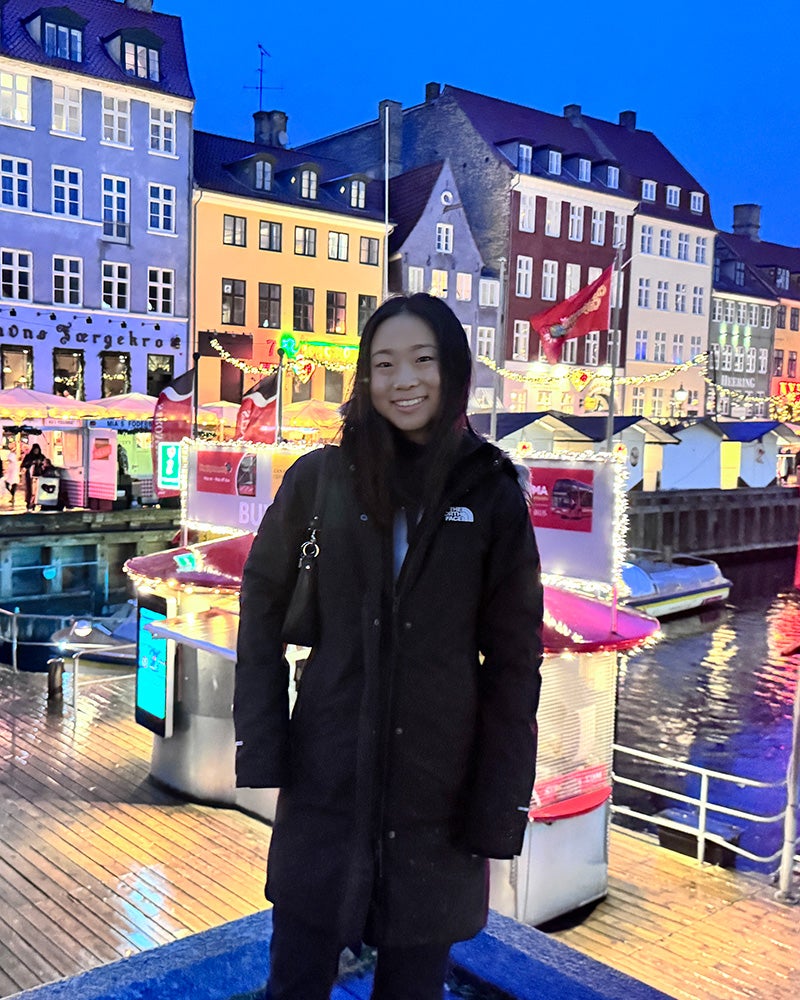
Sophia Zhang (H’27) in the Nyhavn district of Copenhagen
One appeal of the Copenhagen program for HCMP students is the ability to experience a universal health care system firsthand and compare the setup with what is available in the United States.
“The social welfare the Danes have really stands out in terms of health care,” says Zhang. “You are assigned a general practitioner on a yellow card when you arrive in the country. If you need surgery, you walk out without paying. It’s a shock coming from the U.S.”
However, the students weren’t just observing the positive attributes, they were also critically analyzing the trade-offs.
“We discuss the fact that Denmark is a small country of 6 million people, compared to 350 million in the U.S.,” Zhang notes. “We look at the structural challenges, like waiting periods and the role of the [general practitioner] as a ‘gatekeeper’ for everything.”
A Classroom Without Walls
For Parikh, her curriculum extended beyond the classroom into the very design of the city. In her urban planning course, she studied how the “built environment” — bike lanes, pedestrian pathways and access to green spaces — act as a preventative health tool.

(From l) Nitya Nalamothu (H’27) and Dhruvi Parikh (H’27) visited Matthias Church during a visit to Budapest, Hungary.
“I’d argue that I’ve learned just as much about health care through adjacent fields like urban livability,” Parikh says. “Seeing how the Danes plan cities to improve population health directly relates to the social determinants of health we talk about in our Georgetown classes. It brings the theory into practice.”
The Danish program emphasizes experiential learning, taking students out of the classroom and, frequently, out of the country. Zhang’s Comparative Health Care Systems course took her to Rovaniemi, Finland, where she witnessed how Finns use helicopters to overcome transportation barriers to access health care in snowy, rural areas.
Parikh’s course on Medical Biotechnology and Drug Development included a trip to London and interactions with research groups at Novo Nordisk. “We looked at the process of bringing a drug to market and the differences between European and American regulations,” she said.
Nalamothu, who hopes to work at the intersection of law and human rights, chose a course on International Refugee Law. Her studies took her to Lesbos, Greece, to witness the migration crisis firsthand, although she also took notice of the Danish approach to immigration.
“There is an interesting dichotomy here,” Nalamothu says. “Copenhagen is the cleanest, safest, most ‘livable’ city. But 30 minutes away, you can see refugee camps where people are cut off from that welfare system. Studying that disconnect, how legal status impacts physical and mental health, has been eye-opening.”
Hygge, Biking and a Gap Year Culture
Outside of the classroom, the students immersed themselves in Danish culture, specifically the concept of hygge (a mood of coziness and contentment) and the ubiquity of cycling.
“The easiest and fastest way to get around is biking,” says Zhang. “It’s intimidating at first, but it’s how you explore the city.”

The students observed that biking was the easiest and fastest way to get around Copenhagen. (Image credit: Febiyan on Unsplash)
The three students also noted a distinct cultural difference in how Danish youth approach education. In Denmark, taking gap years is normal and there’s no tuition to attend a university, funded by a relatively high tax rate that also funds the nation’s health care system.
“There is no rush for them,” says Parikh. “In the U.S., tuition is expensive, so there is pressure to graduate early and pay back debt and make enough to afford health insurance. But here, people take their time and find the path they want to forge.”
Returning with a New Perspective
As they look toward their senior year, the trio agrees that the semester abroad has been vital for their next steps.
“I would choose this again 100 times over. To do a deep dive into a different health care system and realize how the whole truly operates — it is invaluable,” said Zhang.
Heather Wilpone-Welborn
GUMC Communications
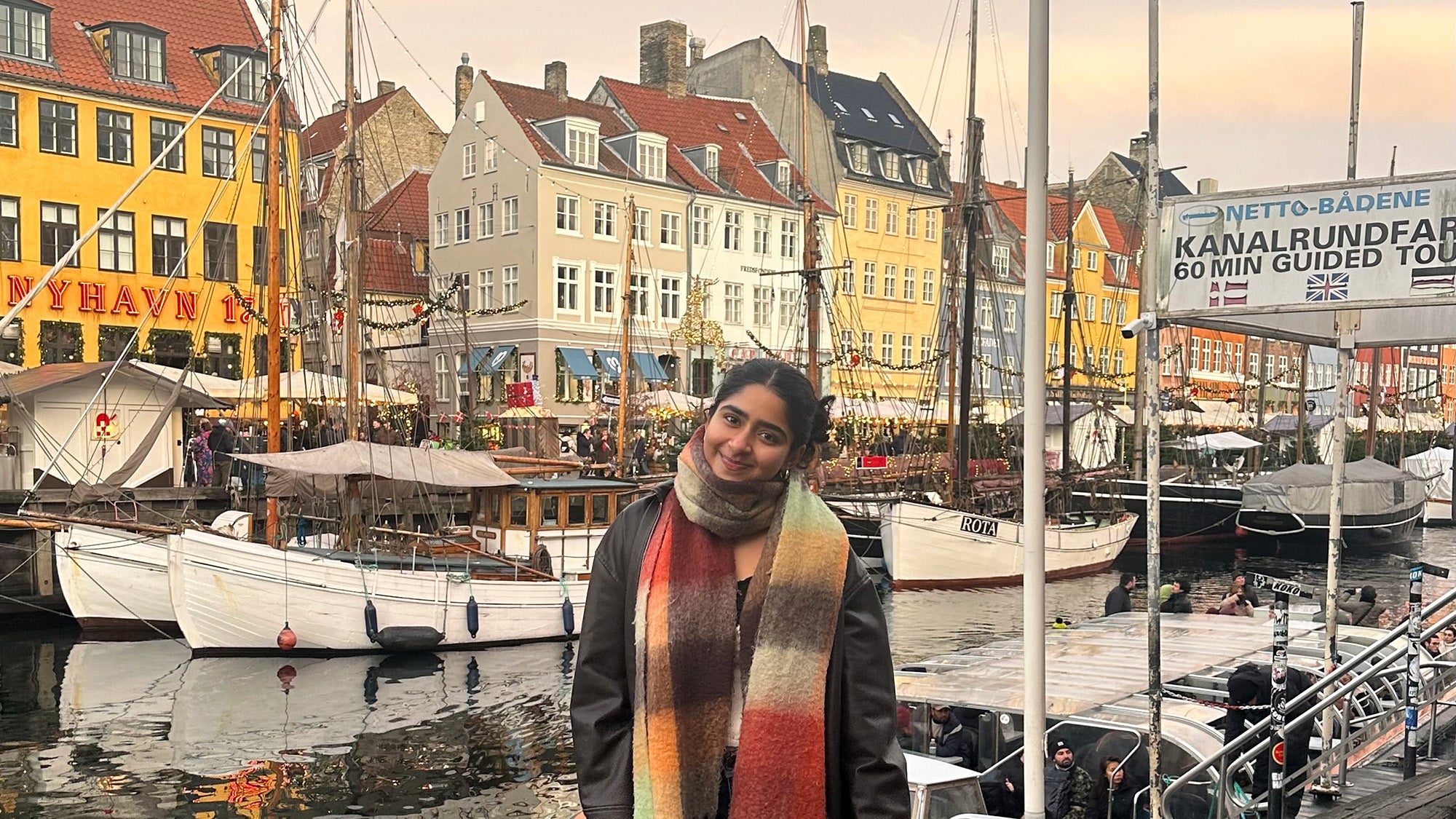
Top Image: Dhruvi Parikh (H’27) in Copenhagen’s Nyhavn district